Listen to this content
The world is rapidly filling with connected devices. IoT Analytics reports that 18.5 billion IoT devices were online in 2024, with growth accelerating toward an expected 21.1 billion by the end of 2025 and 39 billion by 2030. As artificial intelligence drives demand for richer, more precise device data, the need for reliable, high‑accuracy positioning becomes foundational.
Yet today’s GNSS infrastructure — including cellular-based real‑time kinematic (RTK) networks — was never designed for this scale. Billions of devices — from vehicles to drones to industrial sensors — depend on location data, but the traditional GPS model struggles under three converging pressures: (1) massive device growth, (2) rising accuracy requirements, and (3) increasing vulnerability to interference.
These pressures are reshaping expectations for positioning, navigation and timing (PNT) and creating demand for a new, more resilient delivery model.
Why Accuracy and Resilience Matter More Than Ever
Autonomous systems are the clearest example of the accuracy challenge. Xona Space Systems CTO Dr. Tyler Reid notes that safe autonomous driving requires 10 cm accuracy 95% of the time and 30 cm accuracy at “eleven nines” reliability. Standard GPS, accurate only to several meters, cannot meet these thresholds — even with traditional enhancement techniques.
At the same time, GNSS signals face growing threats. Spoofing and jamming events are now daily occurrences in parts of Europe, and U.S. federal agencies increasingly require contract bidders to incorporate resilient PNT technologies alongside legacy GNSS.
Finally, the explosion of IoT devices introduces a network‑scale challenge. Many of these devices could benefit from high‑precision positioning, but continuous unicast RTK streams are not an efficient use of cellular networks, especially as billions of devices come online.
Together, these factors point to a simple conclusion:
A new delivery model for high‑precision GNSS corrections is needed — one that is accurate, resilient, and scalable.
Why a Hybrid Approach Is Required
RTK positioning is the gold standard for centimeter‑level accuracy. It works by combining GNSS signals with correction data from a known base station. However, traditional RTK has two major limitations:
- Coverage constraints — corrections must be delivered within a limited range of the base station due to the fact that accuracy diminishes the further the GNSS base is from the rover.
- Network constraints — corrections are typically delivered over cellular networks, which become inefficient at scale.
Precise Point Positioning (PPP‑RTK) can extend range and reduce dependency on local base stations, but today’s PPP‑RTK implementations are proprietary and lack a common standard.
To support billions of devices — many mobile, many mission‑critical — the industry needs a correction‑delivery model that is:
- Nationwide
- Efficient at scale
- Resilient to interference
- Cost‑effective for high‑volume IoT deployments
This is where hybrid RTK becomes essential.
Introducing Hybrid RTK: A Dual‑Path Delivery Model
Hybrid RTK refers to the dual‑path delivery of GNSS correction data, consisting of:
- Primary path: ATSC 3.0 broadcast
- Fallback path: Cellular (LTE/5G)
- Upstream messaging: Cellular for acknowledgments or device telemetry
Compared to a satellite-based RTK solution or even a cellular-only RTK solution, hybrid RTK will deliver corrections over a far more reliable and scalable network, because it’s both broadcast and terrestrial-based.
Why broadcast first?
ATSC 3.0 provides:
- One‑to‑many multicast efficiency
- Predictable capacity and uniform latency
- Wide coverage footprints
- Strong penetration in dense urban environments
- Lower cost per delivered bit
This makes it ideal for distributing high‑precision correction data to large numbers of devices simultaneously — something cellular networks are not optimized for.
Why cellular second?
Cellular fills in:
- Coverage gaps where ATSC 3.0 is not yet deployed
- Uplink needs (e.g., device status, position feedback)
- Mobility scenarios requiring two‑way communication
The result is a resilient, nationwide correction layer that scales with IoT growth.
EdgeBeam Wireless: A New Entrant with a Broadcast‑First Architecture
EdgeBeam Wireless is deploying a hybrid RTK network that leverages the existing infrastructure of U.S. television broadcasters — including secure facilities, hardened towers, and nationwide engineering resources — for both over-the-air RTK delivery and collocating GNSS base stations.
This approach provides several advantages:
- Accelerated deployment of GNSS base stations designed to complement existing base networks.
- Lower infrastructure costs than cellular‑only RTK networks.
- High reliability through broadcast delivery.
- Scalable distribution for dense IoT environments.
- Nationwide reach as ATSC 3.0 coverage expands.
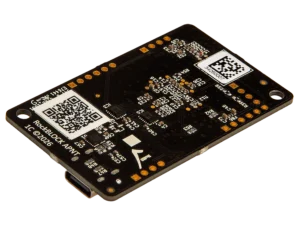
EdgeBeam’s broadcast‑first model — branded by the company as “Enhanced GPS” or “eGPS” — is best understood simply as hybrid RTK with broadcast as the primary downlink. While this hybrid approach does require some additional hardware to receive the broadcast, pricing is already very competitive to cellular because these chips will be found in every television set in the country. Moreover, EdgeBeam already has products available for end users that want to leverage a hybrid network without having to do any development work.
Broadcast RTK: A New Network Layer at the Edge
Broadcast RTK uses ATSC 3.0 to distribute GNSS correction data over the last mile. This creates a new edge network layer that can support both GNSS and other data applications, including:
- High‑precision GNSS corrections
- Multicast distribution of positioning data
- Offloading of appropriate high‑volume traffic (e.g., video) from cellular networks
- Enterprise‑grade reliability for industrial and transportation systems
By shifting the heavy downlink load to broadcast, cellular networks are freed to handle uplink messaging and mobility support — a more efficient division of labor.
This hybrid architecture is not just about improving individual device accuracy. It enables something more powerful.
A New Generation of Shared Situational Truth
When many devices operate on the same centimeter‑accurate reference frame at the same time, a new capability emerges: Shared Situational Truth (also known as shared situational awareness).
This refers to a consistent, real‑time understanding of location and timing across a fleet, system, or environment. Hybrid RTK enables this by delivering synchronized, high‑precision PNT to large numbers of devices simultaneously. By offloading RTK delivery to a broadcast network, cellular and other communication networks can then be used to share a device’s position and other data with other local devices.
What is being shared?
- Precise location
- Precise timing
Who is sharing it?
- Vehicles
- Fleets
- Drones
- Industrial robots
- Infrastructure sensors
- Emergency services
- Insurance and logistics platforms
What does it enable?
Examples include:
- Safer ADAS/ADS through lane‑level awareness
- Collision avoidance for drones and autonomous systems
- Fleet optimization using precise, time‑aligned movement history
- Improved insurance models through reliable behavior measurement
- Faster accident resolution with time-synchronized location records
- Infrastructure‑to‑vehicle coordination for road hazards or construction zones
In transportation alone, EdgeBeam’s hybrid RTK solution could make entire traffic systems safer and more predictable — not just individual vehicles. And importantly, this can be done far more efficiently than via just a cellular-based solution.
Conclusion: A Foundational Shift in PNT Delivery
The convergence of IoT growth, accuracy demands, and GNSS vulnerabilities is forcing a rethinking of how high‑precision positioning is delivered. Hybrid RTK — with broadcast as the primary downlink and cellular as a complementary path — offers a scalable, resilient, and cost‑effective solution.
For industries ranging from automotive to logistics to public safety, the shift from “nice‑to‑have” to “must‑have” high‑precision PNT is already underway. As hybrid RTK networks expand, the ability to deliver centimeter‑level accuracy at scale will unlock new applications, new efficiencies, and new expectations for how devices understand and interact with the world.
EdgeBeam Wireless is building this new correction layer — one designed for the billions of devices that will depend on precise, reliable positioning in the years ahead.