Listen to this content
Not a “hotspot” in the sense of paranormal activity, what goes on in this Calgary facility brings its own kind of magic in the form of GNSS, inertial, anti-jamming/spoofing products, components and solutions.

I last visited Hexagon | NovAtel in 2012, at their previous HQ, which was relatively new at the time. I wrote about this in the Professional Surveyor’s October 2012 issue. Evidently, the operations outgrew that, and they moved to a much larger facility. Recently, while in Calgary for the annual GoGeomatics Expo, I accepted NovAtel’s invitation to visit their new HQ.
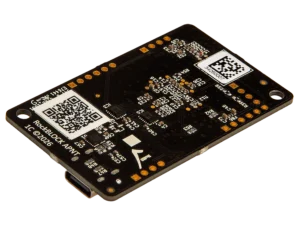
NovAtel has been a leader in the development of products and solutions for both civilian and defense positioning applications — chiefly GNSS and inertial. In addition to standalone branded products, they also provide popular, high-precision OEM components, for example, their OEM7 GNSS boards. You’ve probably used devices that have incorporated these, possibly without being aware of it.
NovAtel was acquired by Hexagon in 2007, and the Calgary building is referred to as the HQ of Hexagon’s Autonomous Solutions Business Area. And indeed, the new facility is emblazoned with Hexagon logos. There are quite a few familiar companies under the Hexagon umbrella that are involved in various aspects of precision positioning. For example, Leica Geosystems and, more recently, Septentrio. For many in the industry and end user communities, the Calgary operation is still referred to as NovAtel.
Neil Gerein, VP of Product, Aerospace & Defence Division Hexagon, was my gracious host and tour guide, as he did in 2012. I was shown a display of the current products, as well as a kind of mini-museum of the company’s past products. Many notable workhorse boards and components.
The Big Umbrella
We spoke about the dynamics of working with other Hexagon companies and divisions that also focus on positioning. “It’s very complementary. We separate out certain aspects, depending on the strengths and specialties of each. We always talk internally: measurement engines versus positioning engines,” said Gerein. “Measurement engine: pseudo ranges, carrier phases, and the raw data coming out of it, this is done by us. We also have positioning engines to calculate position, velocity, and time (PVT) plus attitude, or heading, if the application requires it. However, some customers, like Leica, will run their own positioning engines, for which they have great expertise. The reason is that positioning engines are usually highly tuned to the application. So, you would do different tuning on your Kalman filter for a survey receiver at the end of the pole or coupled receivers that are doing headings on earth-moving equipment, or on a UAV, as opposed to an application we’re doing for defense.” Gerein explained that they work on a daily basis with several groups that are developing and refining various end-use applications but may not be producing their own boards.
In March of 2025, Hexagon acquired Septentrio, a highly respected developer of positioning solutions based in Belgium. “We’re excited to work with those folks, because we’ve known a lot of them personally for a couple of decades,” said Gerein. “For example, Bruno Bougard (VP R&D) and Jan Van Hees (VP Business Development and Product Management), we’ve known each other for almost our entire careers — great mutual admiration and respect for them. This is a really nice acquisition, because it’s not us versus them. It is like we’ve always looked across the aisle at them, respected what they do, and never really competed on many things. We have extensive experience with antennas, anti-jamming, and sensor fusion, and our Septentrio colleagues have extensive experience with GNSS module-level products. So, you combine the two, and it becomes a really nice business because we can play to each other’s strengths. There’s lots we can learn from them, and lots they can learn from us.”
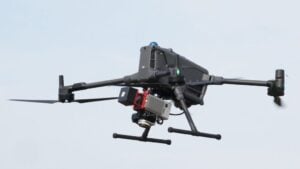
Over the years, I’ve spoken to different product integrators who have tapped NovAtel for GNSS/IMU fusion components, for which they have a well-earned reputation. A few examples include Inertial Labs, a VIAVI Solutions Company, whose RESEPI™ Lite (Remote Sensing Payload Instrument) integrates an OEM7 receiver, and a very clever image-based handheld mapping system from Looq AI, their qCam system, that creates high-resolution 3D models with automatic georeferencing via a Septentrio mosaic-X5 GNSS module.
I asked about the nascent wave of quantum sensors. “We’re always looking at different types of sensors,” said Gerein. “While we’ve historically been GNSS-centric, we now always talk about sensor fusion. So, we’ll take any sort of measurement we can get from anywhere, whether that’s inertial or, potentially, in terms of quantum, what that could do in terms of timing.”
NovAtel has been quite successful in developing solutions to combat spoofing and jamming. I asked how super-strong jammers and spoofers could be dealt with. Gerein explained that there are some misconceptions, and that stronger is not always as effective: “A low-power jammer, closer to the antenna, can have the same effect as a stronger jammer at a further distance. Imagine a garage band playing in your neighborhood. With the guitar amplifiers turned all the way to 11, it can be pretty loud, even if they are rocking it out and ‘jamming’ down at the end of the street. But if they are next door, and the guitar amplifiers are turned to mid-volume, it can still seem just as loud. The same thing happens with GNSS jamming. For example, if there was a 100 Watt GNSS jammer at our current location here at the Hexagon Calgary Campus, that jammer would knock GNSS out for the entire City of Calgary. With our GAJT GNSS anti-jam antenna technology on your vehicle, you would still be able to navigate anywhere in the city, right into our campus parking lot. Eventually, if you got right next to the jammer, you would not be able to ‘hear’ the real GNSS satellite signals and you’d lose your solution. There are examples out in the real world of small 1 Watt jammers, which are still effective at short distances, but harder to ‘hear’ and therefore harder to find. GAJT still effectively mitigates against them. There are also high-power kilowatt jammers, which are ‘loud’ and effective over hundreds of kilometers. Our GAJT equipment is designed to be effective against even high-power jammers.”
Manufacturing
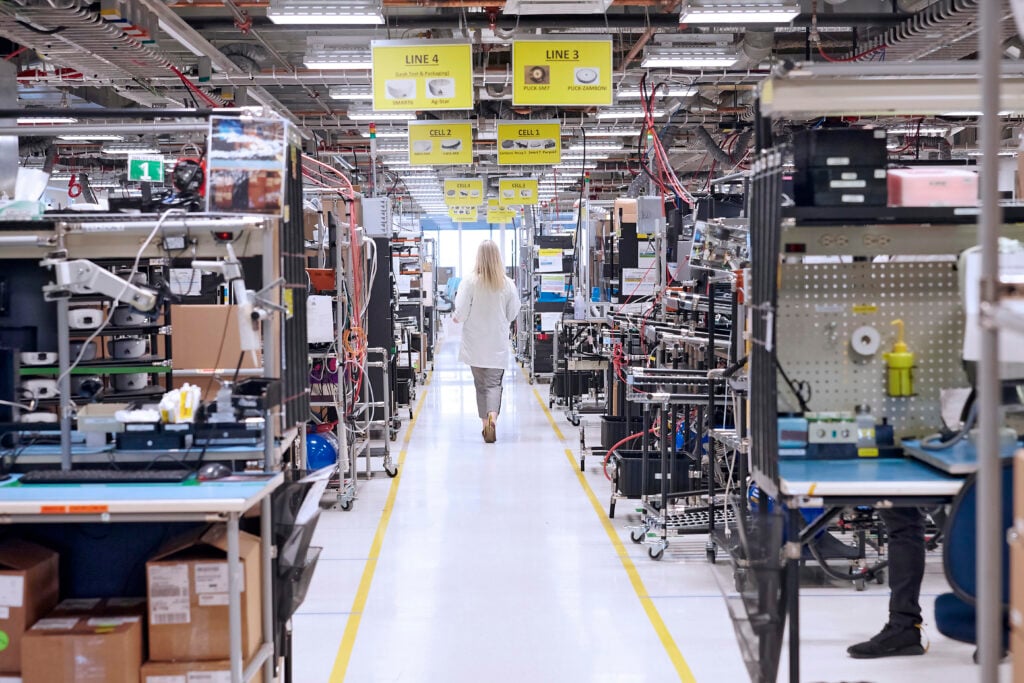
We did a tour of the new HQ, but of course, as they are involved in defense solutions, I was not allowed to photograph much; this was not unexpected. The manufacturing area of the main building was quite impressive, not just for its very modernized and geeky fixtures, but in the approach that incorporates reconfigurable production “cells.” I’ve visited many geospatial product manufacturing facilities over the years, and I’d have to say this one was impressive on many levels, rivalling the splendid efficiency of a Nikon factory I visited.
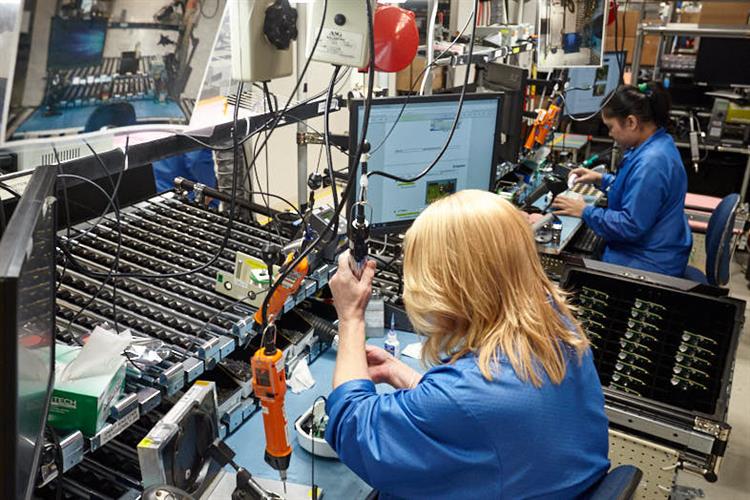
Srikanth “Sri” Anne, Production Manager, led the quick tour of the climate- and dust-controlled production floor. I’d seen cell-based production lines before, but this one takes it a few steps further. “Here we have several cells; some of them are interchangeable,” said Sri. “We are able to reconfigure these cells depending on what the priority of the product is. As we build all the products here, we do our inspection, then the product goes to the finished goods inventory, where our teams load software and authorization codes, pack, and ship.”
The skilled assemblers and testers have a direct hand in designing each cell. “For the benches, we buy the pipe and connectors, and then after that, it’s like Lego, so our teams can configure to whatever they find works best,” said Sri. There’s specific training for everybody, and they can also go to learn something more specialized, like anechoic chamber testing.” Indeed, the speed at which the team worked was impressive. It would take me years to reach that speed—I still struggle with Lego. “It’s this team that decides all the continuous improvements,” said Sri. “It’s the people on the production floor doing the good work.”
I finally got to see an example of ultrasonic welding, using high-frequency vibrations to bond plastic together without the need for glue or adhesives, in a production facility. There’s various aspects of small-scale automation tools, like pulsed drives that count screws and nuts and verify prescribed numbers of turns for each. Considering the dynamics of, and skills required for assembly and testing, I doubt that any humanoid robot could build these units as reliably as these teams.
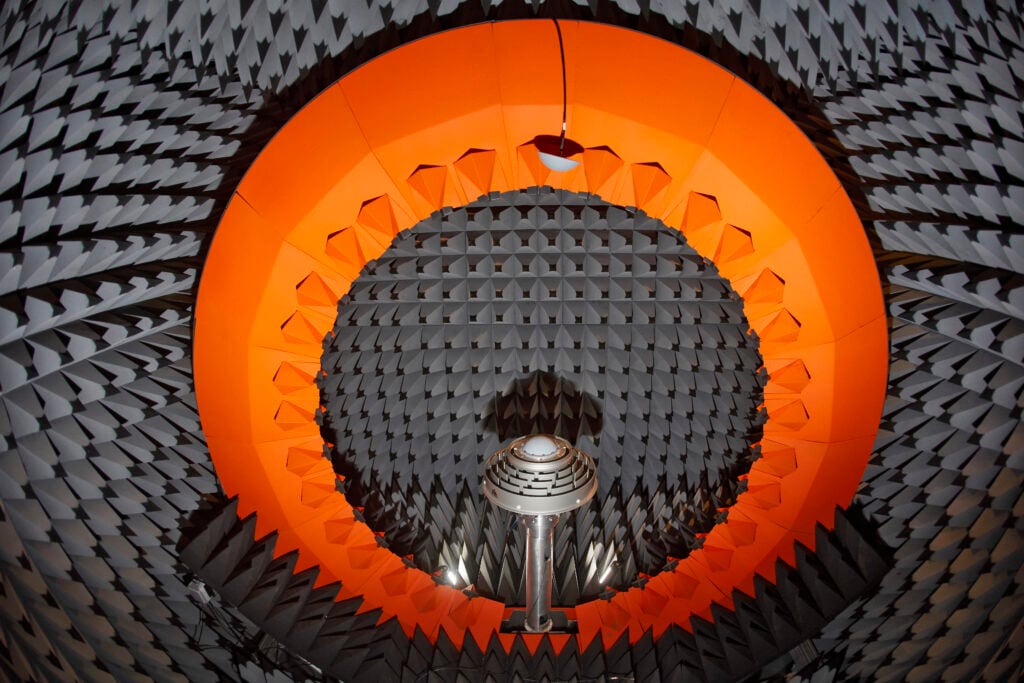
There’s a glass-enclosed subfloor within the main production floor, with higher levels of environmental control. Deep in that room is an anechoic chamber. Such chambers are essential for testing GNSS and other RF technologies. The chamber is lined with baffled panels to eliminate any reflected RF, almost like an RF “vacuum chamber.” Here, antennas and components can be tested in extremely controlled conditions. Engineers can, for instance, record GNSS observations in various parts of the world, under various conditions, and “play them back” in the chamber to any number of antennas to achieve a truly “apple to apple” performance comparison.
I remember being asked at a surveying association meeting what the ultimate method would be to test different GNSS rovers (to see if each respective manufacturer’s performance claims were good). I explained how manufacturers use such chambers for internal R&D and testing. A more practical end-user test might involve putting multiple antennas on one tripod or doing a single antenna split to multiple receivers (like the ISO 17138-8 procedure). However, manufacturers like NovAtel take extra steps, with tools such as anechoic chambers, to ensure consistent and verifiable performance.
The Nerve Center
In another central area of the building is a glass-enclosed room that looks like a central nerve center from a sci-fi movie. Row after row, and panel after panel stretching to the back wall, of blinking lights and cables. Gerein says there are many kilometers of data cables reaching every part of the room, every desk and workbench, and several more kilometers of coaxial antenna cable leading to a huge antenna farm on the roof.
Engineers doing R&D and testing from their desks or workbenches can book processing resources and connect to GNSS antenna feeds. Tapping the massive amount of processing power onsite, signal simulators, and libraries of algorithms, they can try out any number of design options and test these for various expected conditions. This is a far cry from examples I’d seen at other facilities where engineers might have a single antenna lead and use a local computer to do the work.
The Growing Autonomy Market
The subject of autonomy has a lot of buzz, even among the general public, though much of the “news” seems to be about posturing among several aspirants for robo-taxis, and about high-profile failures of auto-driving systems. It seems that true vehicular autonomy might be a long way off, at the consumer level, but the sector continues to grow rapidly, in areas that don’t get as much press. I asked what some of the successful implementations of autonomy have been.
“Our autonomy is focused on a couple of main markets right now,” said Gerein. “Agriculture, defense, and machine control, certainly, but some other interesting applications. There are huge road trains in use in places like Western Australia to get iron ore out to ports. You have multiple trucks towing multiple trailers each. In the past, there were road trains that had a driver in each truck, following each other, and this progressed to just a driver in the lead truck. The evolution is autonomy with safety drivers, to leader-follower, to the eventual goal of full autonomy. The difference between this type of implementation and something on, say, a public highway is that the mines build and own these roads; there is no uncontrolled access, no traffic hazards.”
That is a good point; autonomy can be quite successful right now, in controlled-access situations, like agricultural lands, mining, and construction sites. There’s an unrelated company I learned about, Perrone Robotics, that does autonomy retrofits for small buses and shuttles that operate within university-owned campus road networks. In addition to success in these controlled-access environments, there’s plenty of applications for lane-level navigation and assisted driving. Manufacturers like NovAtel, which develop and produce essential GNSS and IMU components for these, as well as operating global GNSS corrections services, are quite busy moving autonomy forward.
I certainly got to geek out during this visit. Operations like this remind me how much science, engineering, and attention to detail that goes into producing the reliable, high-precision gear we sometimes take for granted. I do worry a bit about a mini-trend where some folks are taking consumer-grade GNSS, IMU, and corrections services and packaging them as “survey grade,” or suitable for full autonomy. There are safety-of-life considerations, so it is a bad idea to employ cheapo approaches. There’s no substitute for the kind of dedication to quality and performance that outfits like this one I visited in Calgary deliver. Beep on!