Listen to this content
DroneShield has introduced RfAI-3, the latest iteration of its proprietary radio frequency intelligence engine, designed to detect drone threats beyond pre-cataloged emitter databases.
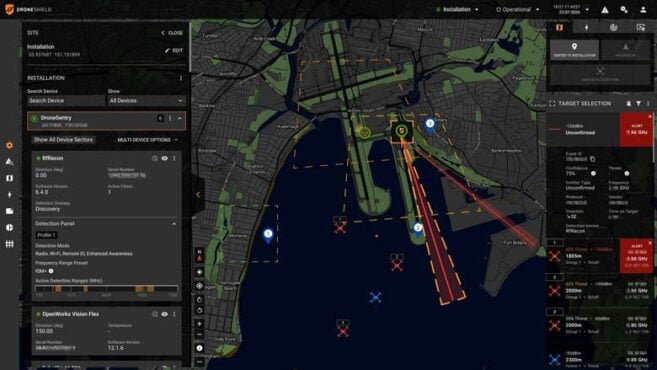
Most RF detection systems require a drone to be previously classified in an RF dataset before it can be reliably identified. DroneShield says RfAI-3 reverses that approach: rather than scanning for known signals, the system detects all emissions present in the spectrum and then attempts to match each against previously observed drone signatures. When a match is found, the emitter is classified with full detail. When it is not, RfAI-3 generates a signature for the unknown emission and presents it to the operator alongside a confidence assessment ranked against the broader spectrum picture. Each new signature generated becomes a reference for future encounters.
“The drone threat doesn’t wait for classification,” said Angus Bean, CEO of DroneShield. “RfAI-3 represents a fundamental shift in how we approach RF-based detection. We are no longer limited to seeing only what we already know. Wideband changes the calculus for our operators and for the adversaries trying to evade them.”
RfAI-3 is the third generation in the RfAI lineage. The original RfAI, developed in 2018, established the company’s foundational RF detection architecture for real-time classification of known drone emitters. RfAI-2, released in 2023, introduced a continuously expanding RF intelligence dataset, with new drone models, protocols, and threat vectors added through DroneShield’s ongoing acquisition and characterization program and distributed to deployed units.
RfAI-3 builds on that foundation while adding wideband detection capability that operates outside the bounds of any existing catalog. The system’s RF intelligence dataset continues to expand over time, meaning a deployment’s performance against classified emitters increases after commissioning without requiring hardware upgrades.
RfAI-3 is designed for DroneShield’s next-generation hardware platforms. Initial releases are expected in the second half of 2026, with further releases planned through 2027. DroneShield’s existing product lineup will continue to receive support under the company’s software subscription model, including ongoing emitter coverage updates.