Listen to this content
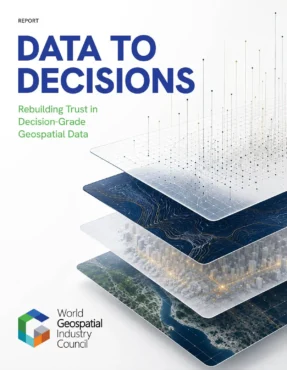
The World Geospatial Industry Council (WGIC) has released its report, “Data to Decisions: Rebuilding Trust in Decision-Grade Geospatial Data.”
The report arrives as the geospatial sector shifts from measurement-based trust to model-based trust — a paradigm where data is increasingly inferred, synthesized and generated at scale by AI systems whose inner workings are difficult to inspect. While this shift unlocks immense value, it introduces hidden risks: silent errors, untraceable lineage, and blurred accountability when critical decisions fail.
WGIC argues that trust must be rebuilt across four key foundations — provenance, governance, metadata, and accountability — and operationalized through emerging standards, federated architectures, and governance-ready geospatial foundation models.
The report develops these foundations into six interconnected properties of decision-grade data — source and capture, integrity and authenticity, provenance and lineage, quality and uncertainty, rights and governance, and fitness for decision.
“The geospatial and EO industry’s next phase of growth will be defined by whether data is decision-grade,” explained Aaron Addison, executive director of WGIC. “The data chain spans from sensor to model to decision. A vulnerability anywhere along this chain propagates downstream, requiring a comprehensive response across the entire ecosystem. This report gives our members and the broader industry a shared reference point at a moment when regulation and AI capability are moving at breakneck speed. It is an invitation to build a trusted future together.”
John Renard, Founder of Airedale Advisory & Chair of the WGIC Data Committee, added, “Machine learning and generative AI, paired with the exponential growth of location intelligence, have tested our confidence in spatial data. This report tackles those questions head-on, challenging existing assumptions. Drawing on broad industry consensus and practical expertise, it offers concrete recommendations to strengthen practice and guide decision-makers through an increasingly complex landscape.”





![Contains modified Copernicus Sentinel data [2016]/ processed by ESA.](https://www.gpsworld.com/wp-content/uploads/2026/08/United_Kingdom-from-Space-300x262.jpg)