Listen to this content
JAVAD GNSS has introduced a GNSS+INS product line: a family of tightly integrated GNSS and inertial navigation solutions now available for evaluation and integration by qualified users. The line pairs JAVAD’s multi-constellation GNSS receivers with proven commercial and defense IMU modules through a purpose-built interface board, giving OEMs a prime navigation system that produces PVT solutions with attitude when satellite signals may be jammed, spoofed, or blocked.
Operators in aviation, maritime and unmanned systems encounter jamming and spoofing worldwide, and the platforms
most affected (such as small UAS, autonomous ground and marine systems) require small compact integrated systems which would allow them to endure navigation gaps. Integrators addressing this have generally had two options: source a GNSS receiver and an IMU separately and absorb the integration work themselves, or buy a sealed GNSS+INS box built around a pre-selected inertial sensor.
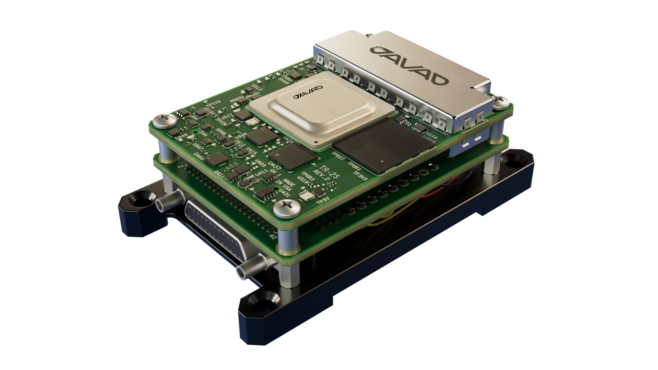
The JAVAD GNSS+INS configuration ships as a pre-assembled
stack-up an integrator can deploy as delivered, or separate
and mount to suit the mechanical constraints of the host platform. The interface board handles the electrical connection, time synchronization, and data path between receiver and IMU, removing the cabling, timing alignment, and sensor calibration work previously required by the integrator.
The inertial sensor is a configuration choice by the end user because the integration lives within the interface board rather than being hard-wired into the receiver. JAVAD integrates the IMU, matched to the program’s grade, dynamic range, and cost requirements, without compromising or impacting the integrity
of the JAVAD GNSS unit.
“Now integrators can get GNSS performance and anti-jam protection while choosing the inertial sensor that fits their program,” said Gary Walker, executive VP at JAVAD GNSS.
Current configurations span gyro dynamic ranges up to ±2000°/s, in-run gyro bias stability from 0.7 to 2°/hr, and accelerometer ranges from ±8 g to ±40 g.