No audio available for this content.
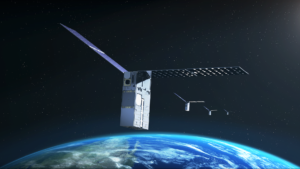
NASA has awarded PlanetiQ a $3.3 million task order to provide GNSS polarimetric radio occultation (GNSS-PRO) and ionospheric total electron content (TEC) data through NASA’s Commercial Satellite Data Acquisition (CSDA) program.
The acquisition will provide NASA researchers with high-SNR observations of precipitation and the ionosphere. The award follows NASA’s June selection of PlanetiQ as a CSDA On-Ramp 2 task-order holder to provide GNSS-PRO data.
Extending GNSS-RO to precipitation
GNSS radio occultation measures how signals from navigation satellites bend and slow as they pass through Earth’s atmosphere, providing detailed profiles of atmospheric properties. PlanetiQ’s GNSS-PRO capability builds on this technique by measuring the horizontal and vertical components of GNSS signals to reveal additional information about precipitation along the signal path.
These dual-polarization measurements, known as polarized RO or PRO, help characterize rain and snowfall vertically in the atmosphere.
“GNSS-PRO gives us a new way to observe the atmosphere,” said E. Robert Kursinski, chief scientist at PlanetiQ. “This acquisition gives NASA researchers an opportunity to create applications using this globally distributed data source to quantify precipitation and clouds at a high vertical resolution.”
Observing the ionosphere
PlanetiQ’s ionospheric TEC measurements provide information about the total number of electrons along the path between a GNSS satellite and PlanetiQ’s receiving satellites. TEC observations can be used to characterize ionospheric conditions and disturbances associated with space weather, which can affect GNSS signals, communications, and other space-based and terrestrial systems.


![Contains modified Copernicus Sentinel data [2016]/ processed by ESA.](https://www.gpsworld.com/wp-content/uploads/2026/08/United_Kingdom-from-Space-300x262.jpg)