No audio available for this content.
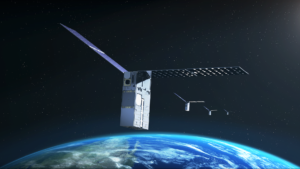
PlanetiQ’s GNOMES-10 satellite launched Oct. 1 at 11:32 a.m. PDT aboard SpaceX’s Transporter-18 mission from Vandenberg Space Force Base, marking another major step in the company’s expansion of its global GNSS radio occultation (GNSS-RO) constellation.
Following launch, PlanetiQ’s partner ground stations quickly established first contact with GNOMES-10, and spacecraft commissioning began immediately.
GNOMES-10 carries PlanetiQ’s fourth-generation Pyxis GNSS-RO receiver, which was built and tested at PlanetiQ’s facility in Golden, Colorado. Pyxis is engineered to capture exceptionally high-quality GNSS signals for radio occultation measurements. Its combination of high signal-to-noise ratio (SNR), high-rate signal sampling, precise timing and advanced antenna design enables PlanetiQ to retrieve highly detailed atmospheric profiles from each radio occultation event.
Pyxis incorporates a high-accuracy oscillator and PlanetiQ’s bespoke satellite antenna design, both engineered to maximize the information captured from each GNSS-RO observation. These capabilities provide detailed measurements of atmospheric structure, including in the lower troposphere and ionosphere.
PlanetiQ satellites simultaneously track signals from all four major GNSS constellations: GPS, BeiDou, GLONASS, and Galileo. Each satellite also uses a wide ±75-degree limb-sounding field of view.
By tracking multiple GNSS constellations simultaneously and observing signals across a wide field of view, PlanetiQ satellites can observe more GNSS transmitters at the same time. This creates more opportunities for radio occultation measurements and enables PlanetiQ to produce more GNSS-RO observations per hour.
The resulting observations provide weather models and other users with highly detailed information about atmospheric structure. PlanetiQ’s high-SNR measurements are particularly valuable for resolving features in the lower troposphere, where atmospheric conditions can change rapidly and where conventional satellite observations can be challenging.
PlanetiQ plans to launch GNOMES-11 later this month, carrying the same fourth-generation Pyxis receiver as GNOMES-10. The addition of GNOMES-10 and GNOMES-11 is part of PlanetiQ’s ongoing effort to expand the availability, quality and diversity of commercial GNSS-RO observations for weather forecasting, space weather, and other mission-critical applications.

![Contains modified Copernicus Sentinel data [2016]/ processed by ESA.](https://www.gpsworld.com/wp-content/uploads/2026/08/United_Kingdom-from-Space-300x262.jpg)