Listen to this content
Odawara Castle: A Gateway into Japan’s Past
Odawara Castle was built more than 500 years ago, with fortifications
first erected during the Kamakura period — a time famous for the emergence of the Samurai and Japan’s first Shogun.
Perched on a hill and surrounded by a moat, its fortifications made it coveted and fought over for generations. It endured three sieges between 1561 and 1590 and was reshaped multiple times by successive rulers.
At times, the legacy of Odawara Castle has been difficult to protect. The entire site was shaken to its foundations by multiple earthquakes and the Meiji government of the late 19th century ordered that all feudal structures be destroyed.
In 1938, what remained of Odawara Castle was made a heritage site and slowly rebuilt. It has remained a delicate piece of history in need of ongoing renovation. With this in mind, the Artec 3D team opted to digitize the entire structure for future generations to enjoy.
Capturing an Entire Castle in Minutes
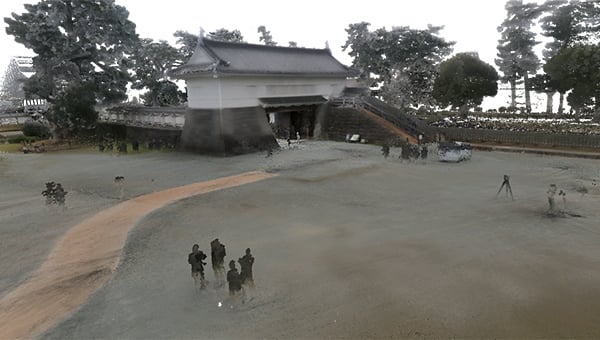
Once one of medieval Japan’s largest fortifications, the castle’s outer defensive perimeter is 9 km long.
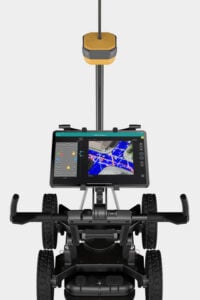
Attached to a backpack, the device enabled full on-foot scanning of the castle, as if the operator were simply a tourist, while capturing the entire scene. Artec Jet’s remote app gave real-time feedback on scan progress, ensuring no details were missed.
“Artec Jet scans in a linear fashion. If it takes you two minutes to walk, it’ll take two minutes to scan — the complexity of the scene has little bearing,” explains Artec 3D scanning expert Keynan Tenenboim. “In the same time it took for Leo to scan two to three walls, Ray II scanned a building, and Jet digitized an entire castle. Adding in Ray II and Leo was great for areas with accessibility issues — and capturing higher detail around the walls, gate and courtyard.”
The Dream Team: Artec Jet, Ray II and Leo
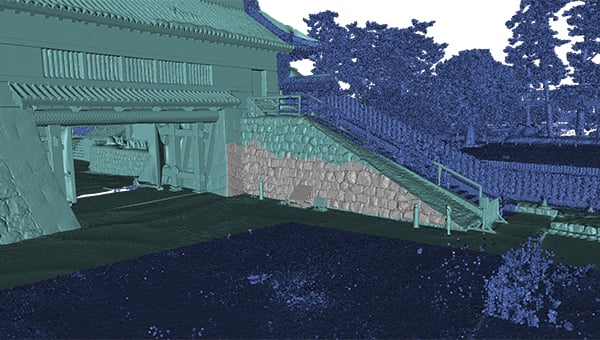
Artec Jet efficiently captured trees, rivers and surrounding areas, generating a continuous point cloud that connected key site features such as historic walls, ornate roofs and courtyards.
Jet’s 300 m range eliminated the need for ladders or scaffolding, allowing the inner structure to be captured discreetly from ground level. Unlike the tripod-mounted Ray II, Jet could be maneuvered into hard-to-reach areas. While both scanners are less accurate than Leo, combining their datasets delivered the best overall results.
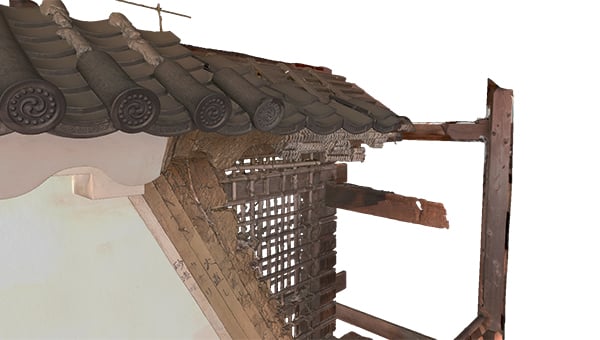
Ray II was deployed to scan the inner courtyard and gate, with Leo being used to pick up smaller details. Handheld 3D scanning also was used to capture a nearby medieval wall. Fine details including tile patterns, lettering and the wall’s internals were captured in a single sweep.
Heritage Preservation with End-Use Potential
Once engineers had finished scanning, they sent data back to Artec’s Luxembourg HQ via cloud sharing for processing in Artec Twins. Artec Twins software allows Artec Jet, Ray and Leo scans to be merged — either into a unified point cloud, or a 3D mesh.
The resulting 3D point cloud could support virtual tours of Odawara Castle and long-term condition monitoring. Regular captures can help detect issues such as roof sagging before major repairs are needed. Artec’s Odawara Castle scan is just the beginning; there are plenty more sites left to explore.
PAUL HANAPHY (phanaphy@artec3d.com) is a journalist turned marketing content writer at Artec 3D. He curates content for those seeking to better understand how 3D scanning works, where it’s beginning to be applied, and how it continues to break boundaries across industries.