Listen to this content
In today’s rapidly evolving UAV industry, GNSS navigation systems face increasingly severe environmental challenges. With the growing density of urban airspace, near-building flights often are required in environments where GNSS signals can be reflected off high structures (multipath), degrading positioning accuracy. As counter-UAV technologies become more widespread, electromagnetic spectrum environments grow increasingly complex, with frequent GNSS interference and spoofing incidents. In mountainous regions, valleys and forested areas, signal blockages and jumps are common, making traditional single-frequency GNSS navigation insufficient for meeting the demands of reliable, high-precision flight. Hangzhou AGR Intelligent Technology Co. Ltd. (AGR), with its deep expertise in industrial UAV applications, chose Septentrio’s mosaic-G5 P3 GNSS module to tackle these complex environmental challenges.
Combined with AGR’s proprietary integrated navigation strategies and flight control system (AG6), this creates an industrial UAV platform capable of maintaining precise, stable and safe navigation in demanding environments.
The mosaic-G5 P3 supports multi-frequency, multi-constellation GNSS reception with low and predictable latency needed for stable and accurate control systems. It leverages AIM+ Advanced anti-jamming and spoofing detection technology for reliable flights in interference-risky zones. Building on this, AGR employs integrated navigation strategies (GNSS/IMU fusion), visual-aided navigation, robust anomaly detection mechanisms, and high-performance flight control algorithms, achieving a “deep integration of hardware and software” advantage that ensures safe and reliable UAV operation across extreme scenarios.
“In complex flight environments — near buildings, in mountainous terrain, or around electromagnetic interference — the mosaic‑G5 P3 GNSS receiver module delivers the robust, high-precision navigation we rely on,” said Chen Liu, CTO of Hangzhou AGR .“Its multi-frequency performance and outstanding high-dynamic navigation capabilities integrate seamlessly with our systems to ensure robust and stable UAV operations”
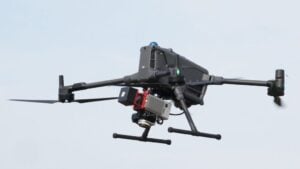
AGR’s B100P multifunctional UAV is now widely used in various applications, including high-altitude cargo transport, high-value material delivery, firefighting, precision agricultural spraying and building facade cleaning, continuously facing evolving environmental challenges.
Why did AGR choose the Mosaic-G5 P3 GNSS Module
- APME+ Advanced Multipath Mitigation algorithm enables reliable flights in reflective zones around high buildings or structures
- Multi-frequency, multi-constellation technology, which makes use of all available GNSS signals for optimal positioning even in partial sky-view environments
- Advanced radio interference mitigation (AIM+) with automatic notch filtering
- High-accuracy RTK positioning
High-altitude transport drones
In complex terrains with severe signal blockages and weak GNSS signals prone to frequent jumps, AGR B100P UAVs — used for material delivery in scenarios such as Four Sisters Mountain races and mountainous logistics — employ the mosaic-G5 P3 module’s multi-frequency, multi-constellation technology for its enhanced signal redundancy. Paired with AGR’s GNSS/IMU fusion algorithms, this greatly reduces signal loss risk and ensures stable navigation along extended, complex routes, improving logistics efficiency and reducing operational risks.
Agricultural spraying UAVs
In mountainous orchards and terraced fields, traditional single-frequency GNSS systems struggle to meet high-precision route planning and operational accuracy requirements. AGR B100P agricultural UAVs utilize the mosaic-G5 P3 module’s high-precision positioning capabilities, combined with AGR’s high-dynamic path optimization algorithms and redundant navigation mechanisms, to operate efficiently and safely even in areas with severe blockages and dense obstacles, significantly improving operational quality and efficiency.
Urban logistics
In complex urban electromagnetic environments (i.e., dense 5G base station areas, industrial parks), the mosaic-G5 P3 module’s AIM+ Advanced technology effectively mitigates various wireless interference signals. AGR’s flight control system continuously monitors navigation status and dynamically adjusts redundant navigation strategies to ensure the stability and safety of various UAV operations.
Through deep cooperation with Septentrio, AGR not only fully leverages the mosaic-G5 P3 GNSS module’s technological advantages but also excels in flight control algorithms and integrated navigation strategies, continuously innovating to deliver a comprehensive, optimized UAV platform for challenging environments. This empowers clients to expand UAV applications in high-difficulty scenarios, opening new horizons for safer, more efficient, and smarter industrial applications.