No audio available for this content.
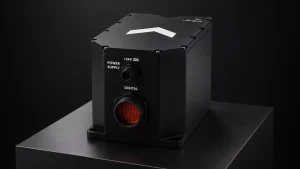
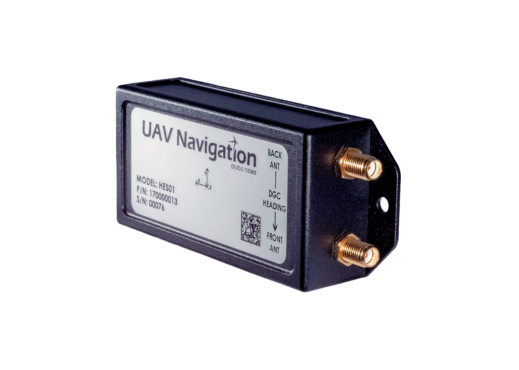
UAV Navigation-Grupo Oesía, which specializes in guidance, navigation and control solutions for unmanned vehicles, has released the HES01, an advanced heading estimation system providing precision navigation for unmanned aircraft systems (UAS). Designed for high performance and reliability, the HES01 integrates the latest technology in a small and easy to install device that delivers very precise heading accuracy and versatility, even in the most complex environments, according to the company.
The HES01 combines dual GNSS signals with RTK precision, an integrated internal magnetometer, and a high-accuracy MEMS-based Inertial Measurement Unit (IMU) to achieve sub-centimeter precision landings when paired with VECTOR autopilots (Flight Control Computer, FCC) and the Ground Hub Unit, GHU-100, the company said.
The HES01 also complements the company’s visual navigation system (VNS01) when operating in hostile or contested environments, where precise heading estimation is essential for GNSS-denied navigation.
The company highlights the following features of the HES01:
- Very accurate heading estimation. Heading estimation accurate up to 0.4º in both static and dynamic conditions, with no alignment maneuver required.
- Heading reference for GNSS-denied navigation, particularly in demanding applications such as effectors and loitering munitions operating in contested environments, making the HES01 complementary to vision-based navigation, such as VNS01.
- RTK-based autonomous recovery on moving decks. The HES01 tracks a landing point that moves with the mothership. RTK corrections provide centimeter-level relative positioning, while the internal IMU compensates for GCS motion, a capability particularly relevant for maritime operations, where it also compensates for pitch, roll, and heave (the vertical motion due to swell).
- Magnetic heading that holds up under EMI (Electro-Magnetic Interferences). The HES01 continuously validates magnetic data against GNSS-derived heading, detecting potential inconsistencies before they affect the navigation solution. This provides the autopilot with a reliable heading reference even in electromagnetically challenging environments.