No audio available for this content.
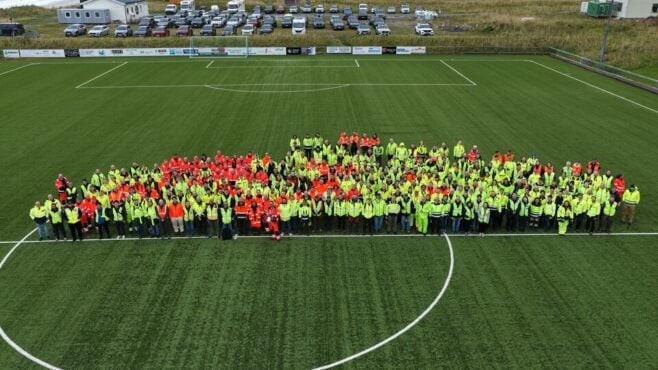
Every September during week-long Jammertest, the airwaves above the Arctic island of Andøya, Norway, become some of the most heavily attacked in the world during Jammertest.
From the small village of Bleik, 69 degrees north, Norwegian authorities launch hundreds of jamming and spoofing attacks, allowing participants to test their technologies against realistic threats, identify weaknesses in them and ultimately develop stronger positioning, navigation and timing (PNT) solutions.
There are several types of intentional interference:
- Jamming occurs when a powerful signal floods a receiver, drowning out the real satellite signal. The receiver can no longer calculate a position, so the blue dot on the map turns grey and disappears.
- With spoofing, the blue dot is still there, but it is in the wrong place. False signals trick the receiver into calculating an incorrect location.
- In a meaconing attack, signals from real satellites are captured and rebroadcast to a nearby location. The time or place shown by the receiver are wrong.

At Jammertest, simple receivers are constantly fooled: the blue dot on a maps app suddenly disappears, only to materialize in the middle of a lake or out at sea. A sports app tracks endless circles at impossible walking speeds. Smartwatches even appear to travel in time.
So participants from institutions and industry take their innovative technologies to Jammertest to find out what works — and what doesn’t — when it comes to protecting receivers against such attacks.
The European Space Agency (ESA) has been a regular participant since 2023. As the architect of Europe’s satellite navigation systems, ESA continuously works on strengthening their resilience.
“Jammertest has become a fundamental complement to our testing activities at ESTEC and in the field. It allows us to take a version of our lab on wheels and test innovations in a real-world environment, under conditions that are impossible to fully replicate in testing facilities,” explained Jörg Hahn, ESA’s Galileo Head of Engineering.
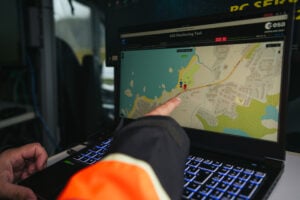
This year, ESA had its largest testing portfolio yet. From new encrypted signals to sophisticated antennas, the team was busy testing technologies for a range of ESA navigation programs.

Galileo achieved SAS civil authenticated position fix
For two hours on the afternoon of Sept. 16, five operational Galileo satellites broadcasting over Europe transmitted a new encrypted signal for testing. On the ground at Jammertest, receivers successfully established their location using these encrypted signals, marking the first real-world positioning using Galileo’s upcoming Signal Authentication Service (SAS).
SAS, including the already available Open Service Navigation Message Authentication (OSNMA), will allow receivers to detect and reject a wide range of spoofing attacks.
This achievement was possible thanks to the close cooperation between the partners in the Galileo program: ESA, the European Commission and its Joint Research Center, and the European Union Agency for the Space Program.

Receivers track Celeste signals
In April, engineers in ESA’s navigation lab captured the first signals from the two Celeste demonstration satellites. Since then, they have been testing all their capabilities, confirming the strong potential of satellites in low Earth orbit to support resilient navigation solutions.
At Jammertest, both satellites flew over Andøya, providing an opportunity to track the signals in realistic conditions.
Celeste’s signals were loud and clear, with preliminary results indicating that they were acquired by receivers on ground, also under contested conditions.
The data collected will be further analyzed at ESA ESTEC’s navigation laboratory.
Horizon Europe monitoring stations for EGNOS
The EGNOS team also contributed equipment for the ESA team to test: two monitoring station prototypes designed to increase the system’s flexibility and robustness.
Developed under the Horizon Europe program, the stations underwent their first field tests at last year’s Jammertest. Building on the lessons learned, upgraded versions of the receivers were back in Bleik this year for further testing.
The goal is for these stations to become operational for the next generation of EGNOS receivers and available for safety-of-life applications.

NAVISP partners
Many NAVISP partners took part in Jammertest, with at least three conducting tests linked to their NAVISP projects:
- NetInsight tested its new Zyntai TimeNode Access, a device that distributes precise timing services for 5G and media, but also for critical infrastructure users.
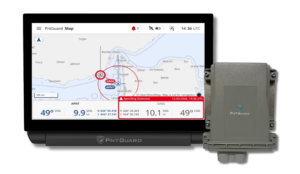
- Dimetor collected information for their NAVSentry solution, which aims to use current telecommunications infrastructure to detect spoofing and jamming.
- Testnor, the organizer of Jammertest, recorded data for their playback service.
Other NAVISP entities participating in Jammertest include ANavS, the Finnish Geospatial Research Institute, Fugro Norway, Indra Space, Kongsberg Discovery, Leonardo, NTNU, Oscilloquartz, Septentrio, Space Norway, Syntony GNSS, Thales Alenia Space Italia, u-blox and Xona Space Systems UK.
While the field campaign is finished, the work is far from over. ESA teams have dozens of terabytes of data to postprocess. Results derived from this week’s testing will keep feeding into the programs throughout the year as lessons learnt, to further strengthen European satellite navigation systems and technologies.