

No audio available for this content.
For decades, positioning, navigation and timing (PNT) services have relied primarily on GNSS operating in medium-Earth orbit (MEO) and these systems transformed navigation and timing worldwide. However, urban canyons, indoor environments, interference, spoofing attacks and increasing dependence on resilient timing infrastructure are all pushing the industry to explore complementary approaches.
The promise of low-Earth orbit (LEO)-PNT has been building for years, and the industry is now moving from theory to reality. With multiple entities actively developing augmented PNT capabilities from LEO, and several already launching operational satellites, LEO-PNT has proven its potential to guide the next era of technology innovation in our physical world.
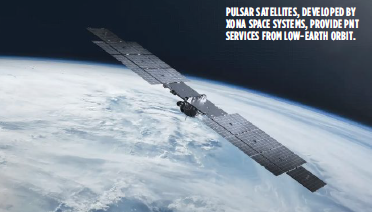
A core player within this space is Xona and its Pulsar constellation. Designed from the ground up as a commercial satellite navigation service, Pulsar targets three qualities that complement current GNSS: signal strength that works where existing signals fails today, centimeter-level native accuracy, and resilience to jamming and spoofing. Rather than reinventing the wheel, Pulsar builds on the L-band spectrum already used by existing GNSS hardware, allowing the billions of new GNSS devices produced each year to access Pulsar’s capabilities without new hardware investment.
The structural difference between MEO and LEO is important; flying roughly 20 times closer to Earth than GPS satellites, Pulsar’s signals arrive with significantly more power — more than 100 times stronger than GPS for users. That geometry also means faster satellite motion across the sky, reducing multipath errors and collapsing convergence times to near-instantaneous, in addition to extending coverage to high-latitude regions underserved by correction services today.
But building a LEO-PNT constellation at scale is not without its challenges. The Pulsar ecosystem is still early: as of mid-2025, one productionclass satellite is in orbit. Receiver adoption, while growing quickly with more than a dozen commercial partners already tracking Pulsar-0, requires continued ecosystem development and access. The software-defined LEO spacecraft can evolve their signal profiles over time, which is a new capability in satellite navigation, enabling PNT infrastructure to improve continuously as the technology it enables matures. But it also means the tools, simulators, and receivers built to support it must be designed with that flexibility in mind. This is where the development ecosystem becomes critical.
The PNT Development Evolution
Historically, PNT development was heavily hardware-centric. Much of the in-depth testing took place at the RF stage, with engineers relying on physical signals and hardware prototypes to validate system performance. This RF-centric approach remains a foundational element of both GNSS and emerging LEO-PNT development today, providing the realism and confidence required for operational systems.
At the same time, the emergence of the “shift left” paradigm in PNT R&D is expanding how systems are designed and validated. Development and testing increasingly occur in software-only environments, allowing engineers to explore new designs and algorithms before hardware is available. This helps identify issues earlier in the development cycle, shortens iteration times and enables solutions to reach deployment more efficiently.
LEO-PNT initiatives have further accelerated the adoption of software-based development workflows. As many of these systems are still evolving rapidly, software-defined environments provide an effective way to evaluate signal designs, receiver algorithms, constellation behavior and interoperability concepts early in the process. At the same time, these workflows build on decades of experience from the broader GNSS industry, where simulation and RF validation have long played complementary roles.
While software-defined testing offers flexibility and scalability, RF validation continues to be an essential part of the development process. Certain characteristics — including receiver sensitivities, interference behavior, timing performance and hardware integration effects — can only be fully understood in realistic RF environments. As a result, modern PNT development increasingly combines software simulation, RF laboratory emulation and eventual field validation as part of a continuous development workflow.





Matteo Luccio
Who sees these comments? ML