Listen to this content
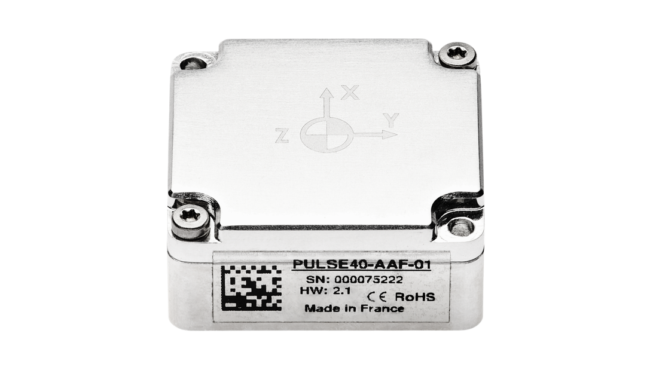
SBG Systems has launched the Pulse-40 OEM, the latest generation of its miniature tactical-grade inertial measurement unit (IMU). Built on the original Pulse-40, the new model delivers improvements in performance, environmental robustness, manufacturing scalability and vibration spectrum monitoring while preserving the compact size, low weight, ultra-low power consumption and integration capabilities of its predecessor.
The new Pulse-40 OEM maintains full form and function compatibility with existing Pulse-40 integrations, allowing customers to upgrade to the latest generation with minimal system redesign.
“The defense market is increasingly looking for navigation and stabilization solutions that fit into smaller platforms without compromising performance,” said Gaël Bielecki, Business Development Manager – Defense at SBG Systems. “The new Pulse-40 OEM delivers exactly that combination. Its unique blend of tactical-grade performance, vibration resilience, low SWaP, and integrated vibration monitoring makes it particularly well suited for guided rockets, precision-guided glide bombs, loitering munitions, and next-generation optronic systems operating in demanding environments.”
Preserved core characteristics
The new version retains the core characteristics of the original, including dimensions of 30×28×13.3 mm, a weight of 19 g, and typical power consumption of 0.3 W. It also preserves tactical-grade inertial performance in an OEM form factor, ultra-low-noise MEMS sensing, continuous built-in test capabilities, a redundant sensor cluster architecture, data output rates up to 2 kHz, and advanced synchronization capabilities.
Higher performance for demanding applications
Gyroscope enhancements include improved bias stability, long-term bias repeatability, and scale factor accuracy. The IMU also introduces a ±4000°/s gyroscope range, doubling the maximum angular rate supported by previous high-range variants, and adds three-axis magnetometers for a complete 9-DoF sensing solution within the same footprint.
Faster measurements with ultra-low latency
An optimized processing architecture delivers motion-to-output latency as low as 1.5 ms, combined with output rates up to 2 kHz, providing rapid access to inertial measurements for time-critical applications.
Enhanced resilience to real-world conditions
An integrated vibration-damping system improves immunity to high-frequency vibrations, while an updated electrical design improves resistance to electromagnetic disturbances, delivering greater robustness in challenging EMC environments.
Built-in vibration intelligence
The new unit features onboard vibration monitoring that continuously analyzes the vibration environment and delivers a complete spectrum from 4 Hz to 8 kHz directly from the sensor, providing both raw FFT outputs and summarized vibration reports. The feature allows users to characterize vibration sources, validate mechanical designs, and simplify troubleshooting throughout the system lifecycle without requiring dedicated external instrumentation.
“Many of our customers operate in environments where vibrations and electromagnetic disturbances can be just as challenging as achieving the required inertial performance,” said Yoann Plenet, Head of Product Management at SBG Systems. “The new Pulse-40 OEM addresses both challenges. This new platform is more resilient to harsh operating conditions, and its unique vibration spectrum monitoring feature gives engineers direct insight into the vibration environment up to 8 kHz.”
Designed for scalable production
The redesigned hardware platform has been optimized for manufacturing efficiency and production scalability, enabling SBG Systems to support larger deployment programs while maintaining the reliability required by mission-critical applications.
Seamless upgrade path
The Pulse-40 OEM maintains the same form factor, mechanical interfaces, and software integration philosophy as the original, allowing current users to benefit from improved performance and robustness while minimizing redesign effort and qualification risk.








![Contains modified Copernicus Sentinel data [2016]/ processed by ESA.](https://www.gpsworld.com/wp-content/uploads/2026/08/United_Kingdom-from-Space-300x262.jpg)