Listen to this content
Asynchronous GBPS can improves both convergence speed and positioning reliability
Precise point positioning (PPP), a high-accuracy GNSS technique, offers the advantage of centimeter-level positioning without relying on local reference stations. However, PPP often requires many minutes to achieve full precision, making it less suitable for dynamic environments.
Previous efforts have shown that ground-based positioning systems (GBPS) can accelerate convergence by providing additional geometric constraints. Yet most GBPS solutions depend on highly accurate time synchronization among base stations, which increases infrastructure costs and limits deployment flexibility.
Asynchronous GBPS (A-GBPS) remove this synchronization burden, but their potential for augmenting PPP has remained largely unexplored. Deeper investigation into practical PPP augmentation with A-GBPS is needed.
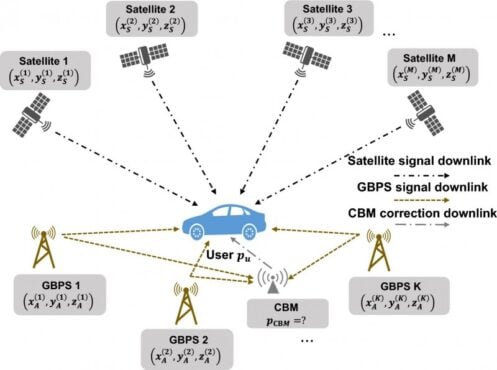
Researchers from the Department of Electronic Engineering at Tsinghua University report a new GNSS augmentation framework in a study published (DOI: 10.1186/s43020-026-00200-4) in the journal Satellite Navigation. The researchers developed a tightly coupled positioning architecture that integrates GNSS with A-GBPS. By combining satellite and A-GBPS observations, the framework significantly accelerates positioning convergence and improves solution stability, offering a practical pathway toward more efficient high-precision navigation services.
Rather than requiring all base stations to share the same clock, the new framework embraces their asynchronous nature. The researchers developed a method that uses a dedicated monitoring station to correct transmitter clock biases before integrating the measurements with GNSS observations. This allows the system to exploit the strong signal power and favorable geometry of ground-based transmitters without the operational burden of network-wide synchronization.
The team first established a theoretical model showing that adding A-GBPS observations should reduce positioning uncertainty. Numerical simulations then demonstrated that adding A-GBPS can significantly strengthen geometric constraints, particularly in the directions where satellite-only positioning is weak. The benefits became even more pronounced after the positioning solution stabilized, suggesting that A-GBPS can complement GNSS throughout the positioning process.
Field test results
To test the approach under real-world conditions, the researchers deployed six A-GBPS base stations and conducted field experiments using a mobile receiver platform. Compared with GNSS-only positioning, the augmented system reached higher accuracy with faster convergence and delivered more stable positioning performance.
The experiments also revealed an important engineering insight: adding more base stations generally improved performance, but the gains began to level off beyond about five or six stations. This finding may help future network designers balance positioning performance against deployment costs.
The authors said the work demonstrates that high-precision PPP augmentation does not necessarily require tightly synchronized GBPS. Instead, asynchronous GBPS can provide valuable geometric information that improves both convergence speed and positioning reliability.
Using existing 5G networks
They said the results indicate that existing terrestrial communication facilities, like 5G, could potentially support future positioning services. Such an approach may offer a practical pathway toward more accessible high-precision navigation without high deployment expense and complexity, which usually associated with synchronized GBPS.
The implications extend beyond navigation research. Faster and more reliable positioning could benefit autonomous driving systems, unmanned aerial vehicles, intelligent transportation networks, surveying operations, and mobile mapping platforms that depend on rapid access to precise location information. Because the framework is compatible with existing radio infrastructure, it may lower barriers to deployment and expand positioning coverage in challenging environments.
The researchers note that future work will focus on eliminating the need for a dedicated monitoring station and evaluating performance under more complex urban conditions, where signal blockage and multipath interference are more prominent.